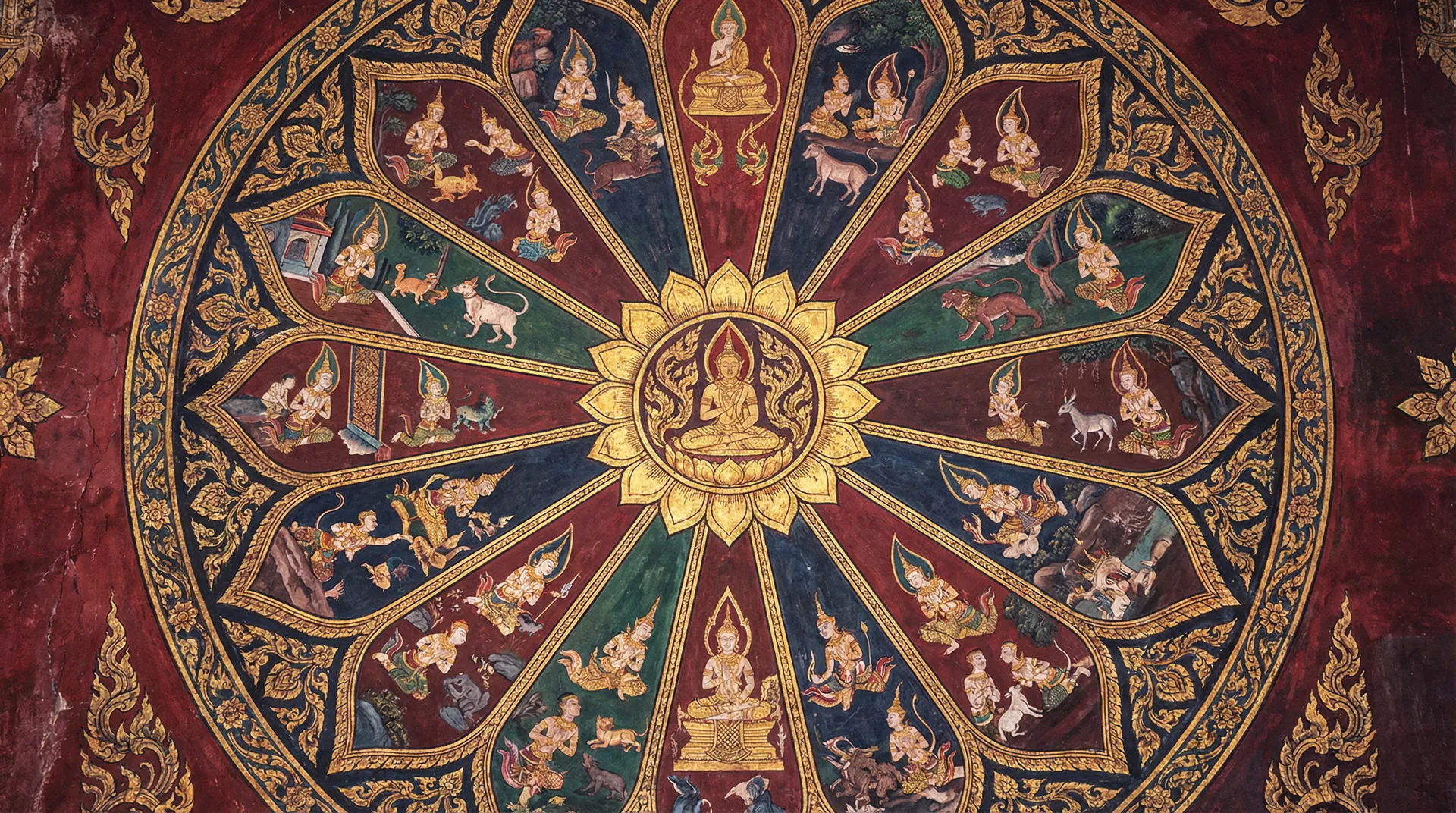
Sālakaṅkāṭa Jātaka
Sālakaṅkāṭa Jātaka
In the bustling city of Varanasi, where the Ganges flowed majestically and merchants plied their trade with fervor, lived a man named Bhadrabala. Bhadrabala was a man of considerable wealth and influence, a respected member of the merchant guild. Yet, despite his outward success, his heart was consumed by a gnawing dissatisfaction, a constant craving for more. He possessed vast estates, a fleet of ships, and coffers overflowing with gold, but the idea of his neighbor's slightly larger mansion or a rival merchant's more exotic silks would plant seeds of envy and discontent in his soul.
He would often sit by his window, watching the world go by, his brow furrowed in thought. "Why should Kasyapa have a finer horse?" he'd mutter, or "That new temple seems to have cost Devadatta a fortune. Is he truly happier than I?" His wife, a virtuous woman named Subhadra, would often try to reason with him. "My lord," she'd say gently, "we have more than enough. We have health, a loving family, and the respect of our peers. What more could we truly need?" But Bhadrabala would wave her concerns away, his gaze fixed on some imagined future where he possessed everything, and thus, he believed, absolute contentment.
One day, a peculiar sight caught his eye. A man, clad in simple saffron robes, sat by the roadside, his head bowed in meditation. What struck Bhadrabala was the man's apparent lack of possessions. He had no fine silks, no golden ornaments, not even a comfortable mat. His worldly wealth seemed to consist of a begging bowl and a simple robe. Yet, as Bhadrabala watched, he saw a profound peace settled upon the man's face, a serenity that Bhadrabala himself, with all his riches, could never attain.
Intrigued, Bhadrabala approached the ascetic. "Greetings, venerable one," he said, his voice betraying his curiosity. "You possess so little, yet you seem to radiate such peace. I, who have so much, am constantly troubled."
The ascetic opened his eyes, which held a depth of ancient wisdom. "Householder," he replied softly, "you speak of possessions, but you mistake the nature of true wealth. I have renounced the world, not out of poverty, but out of a desire for freedom. The more one accumulates, the more one is bound. These chains of desire, of acquisition, are heavier than any gold."
Bhadrabala listened, but his mind, conditioned by years of materialistic pursuit, struggled to grasp the concept. "But surely," he argued, "comfort and security come from wealth? Is it not wise to build a strong foundation?"
The ascetic smiled gently. "A foundation built on sand will eventually crumble. A foundation built on the rock of inner peace, however, is unshakeable. Consider the bird: it flies freely, carrying only what it needs. Consider the river: it flows, giving life, yet it claims nothing for itself. True wealth is not what you possess, but what you can do without."
The ascetic's words planted a seed of doubt in Bhadrabala's mind. He began to observe the world with new eyes. He saw how the pursuit of wealth often led to anxiety, conflict, and a hollow heart. He saw how those who desired less seemed to live with more joy. He noticed how his own constant striving for more left him perpetually restless, never truly satisfied.
One evening, as he sat contemplating, he saw a group of children playing joyfully in the street, their only amusement a simple game with pebbles. Their laughter, pure and unburdened, struck him deeply. He realized that their simple joy stemmed not from possessions, but from their present moment, their connection with each other, and their unhindered spirits.
The next day, Bhadrabala made a decision. He called his wife, Subhadra, and explained his realization. "My dear," he said, his voice filled with a newfound clarity, "I have been chasing shadows. True contentment does not lie in accumulating more, but in appreciating what we have and in freeing ourselves from the burden of endless desire. I wish to live a life of less, not out of necessity, but out of choice."
Subhadra, who had always yearned for a simpler life and a husband free from obsessive ambition, readily agreed. Together, they began to systematically divest themselves of their excessive wealth. They established charitable trusts to support the needy, founded schools to educate the less fortunate, and ensured their children were provided for, but without the ostentatious displays of their former life. They gave away much of their land, their fine furnishings, and their extravagant jewels.
Bhadrabala did not become an ascetic like the one he met. Instead, he chose to live a life of mindful simplicity within his community. He continued to engage in trade, but with a focus on fair dealings and ethical practices, taking only what was necessary and giving generously. He found that with less to manage and less to worry about, his mind became clearer, his heart lighter. He spent more time with his family, engaged in meaningful conversations, and cultivated a deep appreciation for the simple pleasures of life – a warm meal, a clear sky, the company of loved ones.
His former acquaintances were bewildered, even critical. "Why are you giving away your fortune, Bhadrabala?" they'd ask. "You are foolish!" But Bhadrabala would simply smile. He had discovered a treasure far more valuable than gold – the treasure of inner peace and contentment. He learned that true wealth is not measured by what you own, but by how little you need to be happy. His life, once a frantic pursuit, became a serene journey, filled with a joy that no amount of money could ever buy.
— In-Article Ad —
💡Moral of the Story
True contentment and happiness are not found in the accumulation of material possessions, but in appreciating what one has and in liberating oneself from the chains of insatiable desire. Simplicity of life leads to richness of spirit.
Perfection: Renunciation (Nekkhamma)
— Ad Space (728x90) —
More Jataka Tales You May Enjoy
 319Catukkanipāta
Maha-Ummagga Jataka
Maha-Ummagga JatakaIn the heart of the ancient kingdom of Mithila, under the reign of the wise King ...
💡 Profound intelligence, foresight, and logical reasoning are essential for effective leadership, capable of overcoming even the most daunting challenges and ensuring the prosperity and well-being of a kingdom.
 200Dukanipāta
Sutasoma Jātaka
The Tale of the Bodhisattva as a Pacifist KingIn the ancient city of Suvarna, there reigned a king n...
💡 True strength lies in non-violence, restraint, and compassion. Conflicts can often be resolved through dialogue, understanding, and sincere efforts towards peace, rather than through aggression.
172DukanipātaKacchapa Jātaka
Kacchapa JātakaIn the heart of a lush jungle, where ancient trees whispered secrets to the wind and ...
💡 Deception and trickery may offer temporary amusement, but they ultimately lead to suffering. True wisdom lies in honesty, integrity, and using one's abilities for the good of all.
195DukanipātaMahanaradajataka
Mahanaradajataka In the magnificent city of Indrapura, ruled a wise and benevolent king named Brahma...
💡 True enlightenment and ultimate happiness are found not in external pursuits or mythical treasures, but within the awakened mind. Wisdom is the key that unlocks the door to liberation, enabling us to overcome internal obstacles and realize our true nature.
179DukanipātaMahāpuṇṇa Jātaka
Mahāpuṇṇa JātakaIn the heart of the kingdom of Kasi, a land blessed with fertile soil and a prospero...
💡 By consciously pausing and reflecting when anger arises, one can gain control over impulsive reactions, leading to wiser decisions, improved relationships, and inner peace. Cultivating patience and understanding is a path to great merit.
181DukanipātaPañcabrāhmaṇa Jātaka
The Tale of the Five BrahminsIn the ancient city of Mithila, nestled beside the gently flowing Gange...
💡 True wisdom lies not in the accumulation of knowledge, but in self-understanding, humility, cooperation, and the courage to overcome inner fears. Superficial learning is useless without inner strength and practical application.
— Multiplex Ad —